
Samsung Music Studio 7 Review: A Sonos Rival That Sounds as Good as It Looks
Samsung's Music Studio 7 is a $499 wireless speaker with Dolby Atmos, hi-res audio, and a 3.1.1-channel configuration. After three weeks of listening, here is how it stacks up against the Sonos Era 300.
A
admin
April 13, 2026 · 14 min read
Review8.5/10
Overall Score
8.5
out of 10Sound Quality
9
Build Quality
8.5
Features
8.5
Ease of Use
8
Value
8
Three Weeks With Samsung's Flagship Speaker
Samsung has been making audio products for decades, but the company has never posed a serious threat to Sonos in the premium wireless speaker space. Soundbars, yes. Samsung owns that market. But standalone speakers that people choose for music listening? That has been Sonos territory, with occasional incursions from Apple, Bose, and a handful of audiophile brands.
The Music Studio 7 changes that equation. Announced at CES 2026 and shipping as of early April, this $499 wireless speaker is Samsung's most ambitious standalone audio product. It features a 3.1.1-channel driver configuration with Dolby Atmos support, hi-res audio playback up to 24-bit/96kHz, and a design collaboration with acclaimed designer Erwan Bouroullec that makes it one of the most visually striking speakers on the market.
We have been listening to the Music Studio 7 for three weeks in a medium-sized living room, a bedroom, and a home office. Here is what it sounds like, how it compares to the competition, and whether it is worth the asking price.
Buy Samsung Music Studio 7 on Amazon
Design: The Speaker You Want to Show Off
Most premium wireless speakers try to disappear into your room. The Sonos Era 300 is a rounded, inoffensive shape. The HomePod is a mesh-covered cylinder. They are designed to blend in.
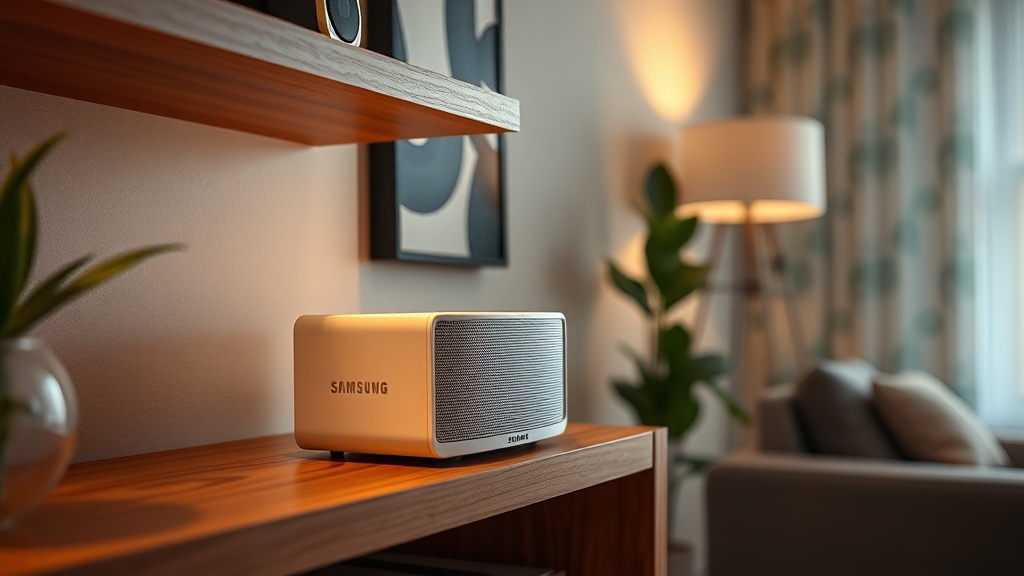
The Music Studio 7 takes the opposite approach. Created in collaboration with Erwan Bouroullec, whose work spans furniture, industrial design, and architecture, the speaker features a distinctive concave dish form with a central dot motif that Samsung calls the "timeless dot concept." It is a design that draws from mid-century industrial aesthetics, evoking a Braun-era minimalism that feels both modern and classic.
The speaker measures 7.28 inches wide, 10.59 inches tall, and 7.50 inches deep, and it weighs 12.3 pounds. It is a substantial object that has real presence on a shelf or table. The build quality is excellent, with a solid enclosure that feels premium and well-engineered. The fabric covering is tightly woven and fingerprint-resistant, and the overall fit and finish is among the best in the category.
Available in a muted color palette, the Music Studio 7 looks good in virtually any interior. We tested it in a modern living room with light wood furniture and in a more traditional home office, and it fit both environments. This is a speaker that people notice and comment on, which is exactly what Samsung and Bouroullec intended.
The physical controls are minimal: a touch-sensitive top surface for volume and playback, with a power button on the rear. Everything else is handled through the SmartThings app. There is no 3.5mm input, but you get a USB-C port for wired audio and service, plus the full suite of wireless protocols.
Sound Quality: Bigger Than It Looks
The Music Studio 7 uses a 3.1.1-channel driver configuration, which means left, center, and right forward-firing drivers, a dedicated woofer, and an up-firing driver for height channels. This is essentially the same approach as the Sonos Era 300, cramming a surround-capable speaker array into a single enclosure.
In two-channel stereo playback, the Music Studio 7 sounds genuinely impressive. The soundstage is wide for a speaker this size, with clear stereo separation and a sense of depth that extends beyond the physical boundaries of the unit. Instruments and vocals occupy distinct positions in the stereo image, and there is a sense of air and openness that is rare in all-in-one speakers.
The midrange is the star of the show. Vocals, whether in a jazz recording, a rock track, or a podcast, are reproduced with clarity, warmth, and natural presence. Male and female voices alike sound full and three-dimensional. Guitar tones have bite and body. Piano has appropriate weight without muddiness.
The treble is detailed and well-extended. Cymbals shimmer with realistic decay. Acoustic guitar strings have proper snap and clarity. High-frequency detail does not sacrifice smoothness, and even at higher volumes, there is no harshness or fatigue.
Bass is the one area where the Music Studio 7 does not fully satisfy. The integrated woofer produces meaningful low-end weight for a speaker this size, and most music genres are served well. Pop, rock, jazz, classical, and vocal music all sound balanced and full. However, bass-heavy genres like electronic music, hip-hop, and modern R&B reveal the physical limitations of the enclosure. Sub-bass below about 50 Hz rolls off noticeably, and if you are used to a dedicated subwoofer or a larger floor-standing speaker, you will notice the missing bottom octave.
This is not a dealbreaker. The bass that is present is clean, tight, and well-defined. It simply does not go as deep as a larger speaker or a dedicated subwoofer-equipped system would. For the vast majority of music listening, the Music Studio 7's low end is more than adequate.
Dolby Atmos Performance: Convincing Spatial Audio
The up-firing driver and the 3.1.1 channel configuration enable Dolby Atmos playback, and in our testing, the spatial audio effect is genuinely impressive for a single speaker.
Playing Atmos-mixed music from Apple Music and Tidal, the Music Studio 7 creates a sense of height and wraparound sound that extends noticeably beyond the physical speaker. Instruments and effects that are mixed to the height channels are clearly perceived as coming from above, and the overall spatial impression is more immersive than standard stereo.
The quality of the Atmos effect depends heavily on the room and the listener's position. Sitting directly in front of the speaker at a distance of 6 to 10 feet, the spatial effect is at its best. Move too far off-axis and the height illusion collapses somewhat, though the stereo image remains wide and engaging.
Samsung also supports Eclipsa Audio, their alternative spatial audio format, which works similarly to Dolby Atmos in practice. Content mastered in either format is handled natively.
The SpaceFit Sound Pro feature uses the speaker's built-in microphones to analyze your room's acoustics and adjust the output accordingly. In our testing, running SpaceFit Sound Pro noticeably improved the bass response and spatial imaging in a room with hardwood floors and minimal soft furnishings. The calibration takes about 30 seconds and genuinely makes a difference, particularly in acoustically challenging rooms.
For movie and TV content, the Music Studio 7 can be paired with compatible Samsung TVs via Q-Symphony, where it works alongside the TV's built-in speakers to create a wider, more enveloping soundfield. We tested this with a Samsung 2026 QLED, and the combination produced noticeably better dialogue clarity and a more expansive sound than either device alone.
Hi-Res Audio Streaming: Audiophile Credibility
The Music Studio 7 supports hi-res audio playback up to 24-bit/96kHz, which puts it in the same territory as dedicated audiophile streamers costing considerably more. The speaker is Roon Ready, which is a significant credential in the hi-fi community and signals that Samsung is serious about audio quality.
Streaming via Roon, we played a variety of hi-res files including 24/96 FLAC recordings from Reference Recordings and 2L. The difference between standard-resolution streams and hi-res files was audible, particularly in the detail retrieval and the sense of space in well-recorded acoustic music. The additional resolution is most apparent in quiet passages, where the noise floor is lower and micro-details emerge more clearly.
AirPlay 2 and Google Cast both work reliably, supporting multi-room audio configurations with other compatible speakers. Spotify Connect is also supported for direct streaming from the Spotify app. Bluetooth is available as a fallback, though Wi-Fi streaming is the preferred method for best audio quality.
The breadth of streaming protocol support is a strength. No matter which ecosystem you are in or which streaming service you use, the Music Studio 7 can accommodate it. This flexibility is one of its key advantages over the Sonos Era 300, which does not support Roon natively.
Buy Samsung Music Studio 7 on Amazon
Smart Features and Setup
Setup is handled through the Samsung SmartThings app, which is both a strength and a limitation. On the positive side, SmartThings provides a comprehensive interface for adjusting EQ settings, configuring multi-room groups, managing streaming sources, and running SpaceFit Sound Pro calibration. The app is well-designed and responsive.
On the negative side, SmartThings is required for initial setup and for many configuration changes. If you are not already invested in Samsung's smart home ecosystem, adding another app to manage a single speaker may feel like unnecessary friction. And while SmartThings has improved significantly over the years, it is not as polished or intuitive as the Sonos app for pure audio management.
Voice assistant support includes Bixby and Amazon Alexa, with Google Assistant available via Google Cast functionality. Bixby handles basic playback commands reliably, and Alexa integration works as expected for smart home control and music requests. The speaker responds promptly to voice commands, and the built-in microphones pick up voice clearly even when music is playing at moderate volumes.
Samsung's integration with their broader ecosystem is where the smart features shine. If you have a Samsung TV, a Galaxy phone, and other SmartThings-compatible devices, the Music Studio 7 slots seamlessly into your existing setup. Q-Symphony with Samsung TVs is a particularly strong feature, allowing the speaker to enhance your TV audio without replacing your existing soundbar or speaker setup.
Comparison to Sonos Era 300
The Sonos Era 300 ($449) is the most direct competitor to the Music Studio 7, and comparing the two is instructive.
Sound quality is close and somewhat subjective. The Sonos Era 300 has a slightly warmer, more bass-forward sound signature that many listeners will prefer for casual listening. The Music Studio 7 has a more neutral, detailed midrange that rewards attentive listening. For critical music appreciation, the Samsung has a slight edge. For background music and general entertainment, the Sonos is equally satisfying.
Dolby Atmos performance is comparable between the two. Both use similar driver configurations to create spatial audio from a single enclosure, and both succeed to roughly the same degree. The Samsung's SpaceFit Sound Pro calibration gives it a slight edge in rooms where manual calibration would otherwise be needed, while Sonos's Trueplay offers similar functionality for iOS users.
Hi-res audio is a clear win for Samsung. The Music Studio 7 supports 24-bit/96kHz playback and is Roon Ready. The Sonos Era 300 supports hi-res streams through its own app but is not Roon Ready, which matters to the audiophile community.
App and ecosystem depends on your existing setup. If you have Sonos speakers throughout your home, the Sonos Era 300 integrates seamlessly. If you have Samsung TVs and SmartThings devices, the Music Studio 7 is the natural choice. For new buyers with no existing ecosystem, Sonos's app is generally considered more polished for pure audio management, though SmartThings has closed the gap.
Design is subjective, but the Bouroullec collaboration gives Samsung a clear design identity. The Sonos Era 300 is attractive but anonymous. The Music Studio 7 is a statement piece.
Price favors Sonos at $449 versus Samsung's $499. The $50 difference is not enormous, but it is worth noting.
Streaming flexibility favors Samsung. AirPlay 2, Google Cast, Spotify Connect, Roon Ready, and Bluetooth give the Music Studio 7 broader compatibility than the Sonos, which relies more heavily on its own app for streaming management.
Who Should Buy the Samsung Music Studio 7
The Music Studio 7 is ideal for buyers who want a premium single-speaker solution with genuine spatial audio capability. If you value detailed, articulate sound quality and want Dolby Atmos support without a full surround system, this speaker delivers.
It is particularly compelling for Samsung ecosystem users. If you have a Samsung TV, Q-Symphony integration adds meaningful value. If you use SmartThings for your smart home, the speaker integrates naturally. And if you are a Galaxy phone user, the seamless Bluetooth handoff and SmartThings integration make daily use frictionless.
Audiophiles and music enthusiasts will appreciate the hi-res audio support and Roon Ready certification. These are not marketing checkboxes; they represent genuine audio quality capabilities that distinguish the Music Studio 7 from most smart speakers.
The speaker is less ideal for bass enthusiasts who want room-shaking low end. If hip-hop and electronic music dominate your listening, you will want a subwoofer or a larger speaker. It is also less ideal for buyers who want portability, as there is no built-in battery. And if you are heavily invested in the Sonos ecosystem, switching to Samsung for a single speaker may create more complexity than it is worth.
The Verdict
The Samsung Music Studio 7 is a serious entry into the premium wireless speaker market. It sounds excellent, with a detailed midrange and convincing spatial audio that rivals the Sonos Era 300. The hi-res audio support and Roon Ready certification give it audiophile credibility. The Bouroullec design makes it one of the best-looking speakers you can buy. And the Samsung ecosystem integration, particularly Q-Symphony, adds practical value for Samsung TV owners.
At $499, it is not cheap, but it is competitive with the Sonos Era 300 and offers broader streaming protocol support and higher-resolution audio playback. The bass limitation and SmartThings app dependency are the most notable drawbacks, but neither is a dealbreaker.
Samsung has been trying to compete with Sonos in the standalone speaker market for years. The Music Studio 7 is the first product where they have genuinely succeeded. It is not a Sonos killer, but it is a credible alternative that some listeners will prefer. And for Samsung ecosystem users, it might just be the better choice.
What We Liked
- Excellent Dolby Atmos from a single speaker unit
- Hi-res audio streaming up to 24-bit/96kHz is outstanding
- Up-firing drivers create a convincingly wide soundstage
- Elegant Erwan Bouroullec design that looks beautiful in any room
- Versatile connectivity with AirPlay 2, Google Cast, Spotify Connect, and Roon Ready
What Could Improve
- Expensive at $499 for a single speaker
- No built-in battery or portable option
- SmartThings app required for full setup and control
- Bass extension could be deeper for the size and price
The Verdict
The Samsung Music Studio 7 is the most compelling challenge to Sonos in the premium wireless speaker market. Its 3.1.1-channel configuration delivers convincing spatial audio from a single enclosure, the hi-res audio support is genuinely audible, and the Erwan Bouroullec design is one of the best-looking speakers we have tested. The $499 price is steep but competitive, and the integration with Samsung TVs via Q-Symphony adds value for Samsung ecosystem users. If you want a premium single-speaker solution with spatial audio, the Music Studio 7 deserves serious consideration.
Was this article helpful?
Join the conversation — sign in to leave a comment and engage with other readers.
Loading comments...
Related Posts
audio
Technics EAH-AZ100 Review: The Audiophile's Earbuds
Apr 13, 2026audio
AirPods Pro 3 Review: The Best Earbuds Apple Has Ever Made
Apr 13, 2026audio
Bose QuietComfort Ultra Earbuds 2 Review: The Noise-Cancelling King Defends Its Crown
Apr 8, 2026audio
Sony WF-1000XM6 Review: The Earbuds That Do Everything Right
Apr 8, 2026Enjoyed this article?
Get the best tech reviews, deals, and deep dives delivered to your inbox every week.