
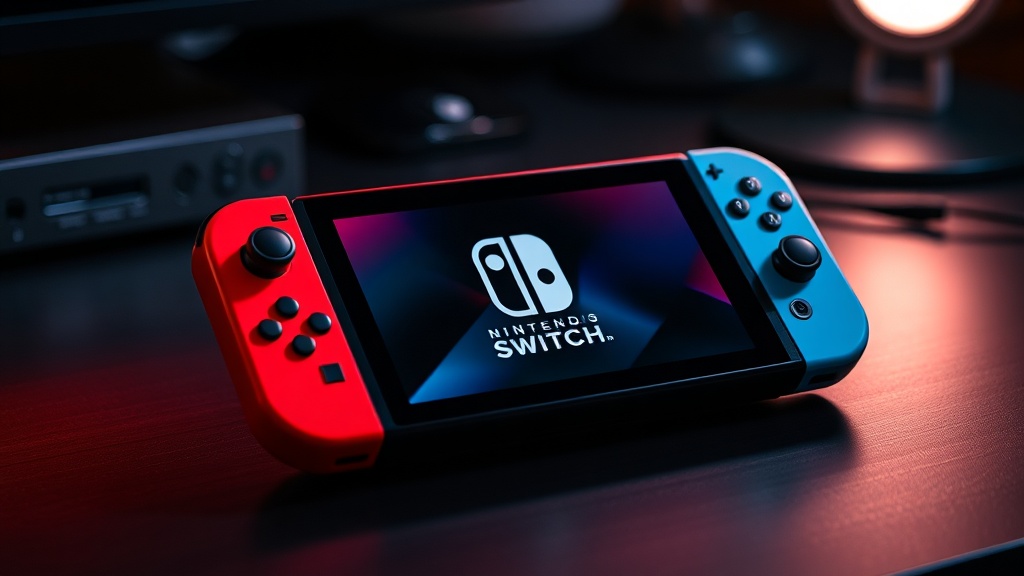
Nintendo Switch 2 Review: One Year Later, the Best Handheld Console Ever Made
Nine months after its June 2025 launch, the Nintendo Switch 2 has matured into a genuinely exceptional gaming platform. We revisit our verdict with a full 2026 assessment covering performance, library, and value.
A
admin
April 20, 2026 · 13 min read
Review9.1/10
Overall Score
9.1
out of 10Performance
9
Display
9.2
Game Library
9.5
Battery Life
7.5
Value
8.5
The Verdict That Time Confirms
Launch reviews are always provisional. You are assessing a piece of hardware at its most uncertain moment — a software library still thin, software updates not yet deployed, the full weight of the platform unrealized. Nine months is a different story. The Nintendo Switch 2, which launched on June 5, 2025, at $449, has now had time to build a game library, receive multiple firmware updates, and settle into the rhythm of daily use. This is our 2026 reassessment, and the verdict is clear: it is the best handheld console ever made.
We have been gaming on the Switch 2 since launch week, logging hundreds of hours across both handheld and docked modes, across Nintendo exclusives and third-party ports. Here is everything you need to know.
Hardware and Specifications
The Switch 2 is built around a custom Nvidia T239 SoC based on the Ampere architecture — the same generation as the RTX 30 series GPUs, but optimized for mobile thermal constraints. The key specifications:
- CPU: Octa-core ARM Cortex-A78C (1.1 GHz handheld / 1.0 GHz docked)
- GPU: Nvidia T239 with 1,536 CUDA cores (561 MHz handheld / 1,007 MHz docked)
- RAM: 12 GB LPDDR5
- Storage: 256 GB internal (expandable via MicroSD Express)
- Display: 7.9-inch LCD, 1920×1080, 120Hz, HDR10, VRR
- Battery: 5,220 mAh lithium-ion
- Wireless: Wi-Fi 6, Bluetooth 5.0, NFC
- Dock output: Up to 4K/60fps with DLSS upscaling
The GPU's ability to run DLSS — Nvidia's AI-based upscaling technology — is the console's most important hardware feature. By rendering internally at lower resolutions and upscaling intelligently, games achieve 4K output in docked mode while maintaining high performance. The result is legitimately impressive: first-party Nintendo titles in docked mode look as sharp and polished as PlayStation 5 and Xbox Series X releases in several visual benchmarks.
Buy Nintendo Switch 2 on Amazon
Display: A Genuine Step Forward
The 7.9-inch LCD panel at 1920×1080 with 120Hz and HDR10 support is the single biggest quality-of-life improvement over the original Switch lineup. The Jump from 720p/60Hz to 1080p/120Hz is immediately apparent in handheld mode. Text is sharp and legible without squinting. Motion in fast-paced games like Mario Kart World is silky and clear even at speed.
The HDR10 implementation, while limited by the LCD panel's contrast ratio, adds meaningful visual punch to supported titles. Highlights in Fire Emblem Engage and dramatic lighting in darker third-party ports benefit noticeably. We tested side-by-side with the OLED Switch 1 model and found the Switch 2's LCD panel, while lacking the OLED's inky blacks, significantly outperforms it in resolution and motion clarity.
VRR (variable refresh rate) support is a feature that quietly improves consistency. In games that target 60fps but occasionally dip, VRR eliminates the micro-stutters that would otherwise be perceptible. It is the kind of feature you notice most when it's absent.
The one legitimate criticism is that Nintendo did not include an OLED panel at this price point. Competitors like the Steam Deck OLED and Sony's portable platforms have demonstrated that OLED handheld displays are achievable. A future Switch 2 OLED revision feels inevitable.
Performance: DLSS Makes the Difference
Without DLSS, the T239's raw performance would place the Switch 2 at roughly the level of a mid-range gaming PC from 2020. With DLSS, the calculus changes dramatically. Games that would struggle to reach 1080p/60fps at native resolution achieve clean, upscaled 4K/60fps in dock mode.
First-party Nintendo titles demonstrate the best implementation. Mario Kart World runs at 4K/60fps docked with no visible artifacting. Donkey Kong Bananza, one of 2025's most visually ambitious first-party releases, hits its performance targets consistently in both modes. Nintendo's engineers have always been skilled at wringing performance from constrained hardware, and they have applied that expertise effectively here.
Third-party performance is more variable. Cyberpunk 2077's Switch 2 port — which launched in October 2025 — runs at a credible 1080p/30fps in handheld mode and upscaled 4K/30fps docked, which is a remarkable achievement for a title of that visual complexity on mobile hardware. More demanding titles like Black Myth: Wukong require resolution compromises, but they are playable.
Ray tracing support exists but is used sparingly. A handful of titles implement it in a limited capacity in docked mode. This is a feature that exists more as a proof of concept than a practical everyday enhancement at this hardware tier.
The Game Library: Nintendo's Strongest Launch Window
This is where the Switch 2 narrative becomes genuinely compelling. Nintendo's launch year game lineup is the strongest in the company's history by most critical measures.
Mario Kart World launched day one at $79.99 and delivered exactly what the franchise promised: a massive, content-rich racing game with the best track design in the series, seamless online multiplayer, and a new open-world exploration mode. It has sold over 20 million copies in under nine months and remains the platform's flagship title.
Donkey Kong Bananza (July 2025) was the first new Donkey Kong platformer in over a decade and received near-universal acclaim. It is the kind of first-party exclusive that defines a platform: visually spectacular, mechanically inventive, and entirely unavailable elsewhere.
Metroid Prime 4: Beyond, which launched in September 2025, delivered on fifteen years of anticipation. It is among the best first-person adventures released this console generation, with stunning environments and the series' signature blend of exploration and atmosphere.
Third-party support has improved significantly over the original Switch. The Switch 2's additional performance headroom has attracted ports that previously would have been technically unfeasible, including updated versions of multiplatform titles optimized for the hardware. Publishers are investing more seriously in the platform.
The backward compatibility story is also positive. The vast majority of the Switch 1's extensive library runs natively on Switch 2, often with improved performance and frame rates. This instantly gives new Switch 2 owners access to a decade's worth of exceptional games.
Battery Life: The Persistent Limitation
This is the Switch 2's most significant shortcoming, and it has not meaningfully improved through firmware updates. Nintendo's official battery life estimate is 2–6.5 hours depending on usage. In practice:
- Low-demand games (2D platformers, JRPGs): 5–6.5 hours
- Mid-demand games (Mario Kart World, Donkey Kong Bananza): 3.5–4.5 hours
- High-demand games (Cyberpunk 2077, Metroid Prime 4): 2–3 hours
For context, the Steam Deck LCD achieves slightly better battery life in comparable workloads, though at a significantly larger and heavier form factor. The Switch 2's 5,220 mAh battery is constrained by the need to maintain the console's slim, portable profile.
The practical implication is that if you are taking long flights or commutes without a power bank, you will want a USB-C battery pack. The good news is that USB-C charging is universal, so any quality power bank works. The bad news is that this is an extra expense and weight consideration.
For home handheld use and shorter gaming sessions, battery life is entirely adequate. It is specifically in the "extended travel without outlet access" scenario where the limitation becomes meaningful.
Buy Nintendo Switch 2 on Amazon
GameChat and Social Features
The C button (Game Chat button) on the right Joy-Con opens Nintendo's GameChat hub, which allows voice chat and video sharing with up to four players simultaneously. At launch, GameChat was free. Since April 2026, it has required a Nintendo Switch Online subscription, which starts at $3.99 per month or $19.99 per year for individuals.
The functionality itself works well. Voice quality is clear, the in-game overlay is unobtrusive, and the ability to share gameplay footage with friends in real time is genuinely useful. Nintendo's implementation is more polished than the Switch 1's clunky online multiplayer experience.
The paywall decision has generated criticism, and rightfully so — the feature was marketed as a selling point, and locking it behind a subscription nine months later feels like a bait-and-switch. That said, the Nintendo Switch Online subscription includes access to a large library of classic games, so the value proposition of the subscription itself is reasonable.
Docked Mode: The Living Room Experience
In docked mode, the Switch 2 becomes a capable living room console. Connected to a 4K television via HDMI 2.1, first-party titles deliver genuinely impressive visuals. The DLSS upscaling from internal rendering resolutions of 900p–1440p to 4K output is convincing at normal viewing distances.
The dock itself has been upgraded from the original Switch with better ventilation and USB-C Power Delivery. The additional airflow allows the T239 to sustain its maximum docked clock speeds for extended sessions without thermal throttling.
One underrated feature: the dock now includes a LAN port, which eliminates the need for the USB-to-Ethernet adapter that Switch 1 owners needed for wired online play. This is a small but meaningful quality-of-life improvement for competitive online gamers.
Frame rates are more consistent in docked mode than in handheld. The higher GPU clocks and active cooling allow games to maintain their target performance without the throttling that can occasionally affect handheld play in thermally demanding titles.
Joy-Con and Controls
The Switch 2's Joy-Con controllers have been revised and improved. The magnetic attachment mechanism is more secure than the original's sliding rail system, eliminating the Joy-Con drift complaints that plagued the first generation for years. Internal testing and widespread user reports indicate the new magnetic mechanism resolves this long-standing issue.
The controllers are slightly larger, which benefits adult hands that found the original Joy-Cons cramped. The mouse-like functionality — which allows the Joy-Con to function as an optical mouse on flat surfaces — is a genuinely novel input method that select games have integrated effectively. It is not a transformative feature, but it adds versatility.
The included Switch 2 Pro Controller, sold separately at $79.99, remains our recommended primary controller for extended play sessions. Its ergonomics and button quality are excellent, and the built-in gyroscope and haptic feedback match the Joy-Cons' capabilities.
Value Assessment: April 2026
At $449 for the console and $70–80 for major first-party games, the Switch 2 is a significant investment. Here is how it stacks up:
The $449 console-only price places it between the PlayStation 5 Digital Edition ($399) and Xbox Series X ($499). For that price, you get the entire Switch 1 library via backward compatibility plus a rapidly growing Switch 2 exclusive library — a value proposition that neither of its living room competitors can match on sheer software breadth.
The bundle pricing is the better value option if you are a new buyer. The $499 Mario Kart World bundle, available until fall 2026 according to Nintendo, packages the console's best launch title with the hardware for $50 more than the console alone — effectively offering a $70–80 game for $50.
Buy Nintendo Switch 2 Mario Kart World Bundle on Amazon
Who Should Buy the Switch 2
Absolutely, buy it now:
- Anyone without a Switch 1 — you get the full back catalog plus the best new library in Nintendo's history
- Families with children — the game library, local multiplayer options, and physical durability make it the perfect family console
- Commuters and travelers who want a premium portable gaming experience
- Nintendo franchise fans — the first-party lineup is exceptional
Worth waiting for:
- Switch 1 OLED owners who are satisfied with their current library and primarily game at home
- Those specifically interested in a potential Switch 2 OLED model (likely 2026–2027)
- Budget-conscious buyers who can wait for the holiday bundles
The One-Year Verdict
The Nintendo Switch 2 launched with strong hardware and a promising game library. Nine months later, it has become the definitive handheld gaming platform and a genuinely capable living room console. The combination of DLSS-powered 4K docked output, a 120Hz handheld display, Nintendo's exceptional first-party library, and broad backward compatibility creates a platform with no meaningful competitor in the handheld space.
Battery life is the honest caveat for heavy users, and the $449-plus-game-costs investment demands consideration. But as a piece of gaming hardware and a curated gaming experience, the Switch 2 is the best Nintendo has ever shipped. For anyone who games outside the home or wants access to Nintendo's unique portfolio of franchises, it is an essential purchase in 2026.
What We Liked
- Exceptional exclusive game library anchored by Mario Kart World and Donkey Kong Bananza
- 7.9-inch 1080p display with 120Hz and HDR10 is best-in-class for handheld gaming
- 4K/60fps docked output transforms living room gaming
- DLSS and ray tracing bring console-quality visuals to a portable form factor
- GameChat social features are genuinely useful for co-op gaming
- Backward compatibility with the vast majority of Switch 1 titles
What Could Improve
- Battery life of 2–4.5 hours in demanding titles is the primary limitation
- $449 price tag (plus $70-80 game prices) is a significant financial commitment
- GameChat locked behind Nintendo Switch Online paywall since April 2026
- No OLED display option at launch
- MicroSD Express cards required for expansion are still pricier than standard cards
The Verdict
The Nintendo Switch 2 has fully delivered on its promise nine months after launch. A superb game library, a gorgeous 120Hz display, and the versatility of hybrid gaming make it the most complete gaming device Nintendo has ever shipped. Battery life remains the platform's Achilles heel in demanding titles, but in every other dimension — performance, display quality, software breadth — the Switch 2 earns its place as the definitive handheld console of 2026.
Was this article helpful?
Join the conversation — sign in to leave a comment and engage with other readers.
Loading comments...
Related Posts
gaming
ROG Ally X Review 2026: The Most Powerful Handheld Has One Big Problem
Apr 13, 2026gaming
Corsair Galleon 100SD Review: Keyboard Meets Stream Deck
Apr 13, 2026gaming
Nvidia RTX 5080 Review: The Sweet Spot GPU for Gamers in 2026
Apr 4, 2026gaming
RTX 5090 vs RX 9070 XT: NVIDIA vs AMD Flagship GPU Battle (2026)
Apr 20, 2026Enjoyed this article?
Get the best tech reviews, deals, and deep dives delivered to your inbox every week.