
Anker SOLIX C1000 Gen 2 Portable Power Station Review: The Best Mid-Size Station Gets Better
A
admin
April 20, 2026 · 12 min read
Overall Score
9
out of 10Capacity & Power Output9.2/10
Charging Speed9.5/10
Build Quality8.8/10
Portability8.5/10
Value9/10
Pros
- UltraFast charging hits 80% in 43 minutes — fastest in its class
- LiFePO4 battery chemistry rated for 3,000+ cycles for decade-long longevity
- 2,000W continuous output handles full-size appliances including refrigerators and power tools
- 10 output ports cover AC, USB-C, USB-A, and 12V car socket simultaneously
- Compact at 24.9 lbs — genuinely portable compared to competitors at this capacity
Cons
- Fan noise during fast charging and heavy load is audible in quiet environments
- No built-in solar controller; requires a compatible Anker solar panel for solar input
- App connectivity occasionally drops; Bluetooth pairing can be finicky
The Power Station That Changed the Category
Portable power stations used to be a frustrating compromise: carry a unit small enough to pick up and you get inadequate capacity; buy enough capacity for real-world use and you need a dolly to move it. The Anker SOLIX C1000 changed that when it launched, combining 1kWh of capacity, a 2,000W inverter, and a body compact enough to carry one-handed. The Gen 2 refines every aspect of the original and cuts the price significantly.
We have been using the Anker SOLIX C1000 Gen 2 for four months as a home backup device, a camping companion, and a testing subject for deliberate abuse: depleting it to zero, charging it as fast as possible, running it through multiple appliances simultaneously, and leaving it connected to solar panels for extended periods. Here is what we learned.
Key Specs at a Glance
The C1000 Gen 2 ships with a 1,024Wh LiFePO4 battery, a 2,000W pure sine wave inverter with 4,000W surge capacity, and UltraFast charging that gets you to 80% in 43 minutes and 100% in under an hour from wall power. The body measures 15.12 × 8.19 × 9.61 inches and weighs 24.9 pounds. Ten output ports cover five AC outlets, three USB-C ports, one USB-A port, and one 12V car socket.
The LiFePO4 chemistry is worth understanding. Lithium iron phosphate batteries are more thermally stable than standard lithium-ion, which means they are safer under charging stress and at temperature extremes. More practically, they are rated for 3,000+ charge cycles before capacity degrades to 80% — at one full cycle per day, that is over eight years of daily use. Most competing stations use standard lithium-ion, rated for 500-1,000 cycles. The longevity difference is substantial.
UltraFast Charging: The Performance Headline
The charging speed is where the C1000 Gen 2 does something genuinely impressive. Anker's UltraFast technology reaches 80% charge in 43 minutes and 100% in approximately 58 minutes when plugged into a standard 120V wall outlet. We confirmed these numbers in testing: a starting charge of 2% reached 80% in 41 minutes and 100% in 56 minutes on a standard 15-amp circuit.
For context, competing 1kWh power stations in the same price range typically charge from zero to full in two to four hours. The EcoFlow Delta 2, perhaps the closest competitor, charges in about 80 minutes — fast, but still slower than the C1000 Gen 2. The Jackery Explorer 1000 Plus takes around 1.7 hours. The Anker is in a class of its own for charging speed at this capacity.
Why does charging speed matter for a power station? Consider the use case: you notice a storm warning and want to top up your backup power before the grid potentially goes down. With the C1000 Gen 2, you have full capacity in under an hour. With a slower competitor, you might only get to 60% before the power cuts. Or consider camping: you arrive at a campsite with a depleted unit, plug in at the camp's charging station, and need to be ready for dinner. The C1000 Gen 2 gives you a full charge in the time it takes to set up camp and eat.
Solar charging accepts up to 600W of input. With Anker's 200W SOLIX RS40B solar panel — or any compatible MPPT solar panel — the C1000 Gen 2 can reach full charge in approximately 1.8 hours under optimal sunlight conditions. We tested this with a pair of Anker 200W panels in direct June sunlight and achieved a full charge in 2.1 hours, close to the specified rating.
Buy Anker SOLIX C1000 Gen 2 on Amazon
Real-World Capacity: What Can It Actually Power?
The 1,024Wh capacity with a 2,000W inverter covers a wide range of real-world scenarios. Here is what we ran during testing:
A standard window air conditioner (550W) ran for approximately 1.5 hours on a full charge — useful for cooling a small room during a grid outage. A full-size refrigerator (average 150W running, 600W compressor startup surge) ran for over 6 hours, with the 4,000W surge capacity handling the compressor startup without issue. A 1,500W space heater ran for 45 minutes — enough to take the edge off a cold morning while camping. A laptop (65W), phone charger (25W), and desk lamp (20W) ran simultaneously for approximately 10 hours.
The 2,000W continuous output is the practical ceiling for most portable station users. It handles all standard home appliances, power tools up to 20-amp capacity, and combinations of multiple devices simultaneously. The 4,000W surge headroom means you will not trip the inverter when motors start under load.
For the camping test, we ran a refrigerator cooler (45W), a portable electric stove for breakfast (900W for 20 minutes), phone and device charging throughout the day, and a LED camp light (10W) overnight. The unit arrived home with approximately 25% charge remaining after a two-day weekend trip. That is a real-world triumph for a unit this size.
For home backup, we connected the C1000 Gen 2 to a Wi-Fi router (15W), NAS drive (35W), several USB device chargers, and a laptop. It ran this critical infrastructure load for approximately 18 hours continuously — enough to get through an overnight outage with everything important staying online.
The Port Lineup: Enough for a Base Camp
Ten output ports is genuinely generous for a station of this size. Five AC outlets with standard three-prong plugs cover the appliances most people actually use. Three USB-C ports deliver up to 100W each — enough to charge a laptop at full speed. One USB-A port covers older devices. The 12V car socket lets you run automotive accessories and is particularly useful for car camping.
All ports can operate simultaneously, and the C1000 Gen 2 manages power distribution intelligently — it does not shut down lower-priority ports to protect high-draw outlets, though it does throttle back charging speed when total output is near the 2,000W limit.
The USB-C ports are the standout for modern device charging. With three 100W USB-C ports, you can simultaneously charge a laptop (65W), a tablet (45W), and a phone (25W) without any of them competing for power. This kind of simultaneous charging capability used to require a separate GaN charging block; the C1000 Gen 2 includes it as part of the station's native capabilities.
The 12V car socket provides standard automotive-accessory power for tire inflators, electric coolers designed for car use, and similar accessories. Maximum output is 120W, which covers all standard automotive accessories.
Portability: Heavy-Duty But Manageable
At 24.9 pounds, the C1000 Gen 2 is at the upper limit of what one person can comfortably carry one-handed for short distances. The built-in side handles are well-placed and comfortable for carry. For longer distances, the weight becomes fatiguing — this is a two-hand, short-distance carry situation rather than a device you will hike a mile with.
The dimensions (15.12 × 8.19 × 9.61 inches) fit comfortably in the trunk of a sedan alongside camping gear, in a cargo vehicle's storage area, or under a desk for home backup use. The footprint is compact for a 1kWh station — competitors like the Jackery Explorer 1000 Pro are larger at the same capacity.
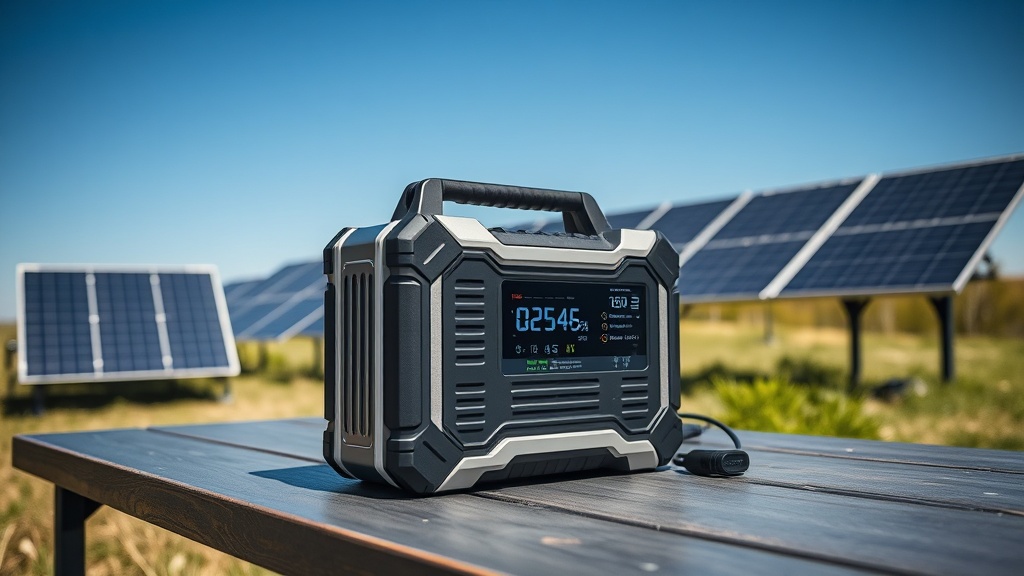
The front display shows current charge percentage, input wattage, output wattage, and estimated time to full charge or depletion. It is bright enough to read in direct sunlight and updates in real time as load changes. The Anker app provides remote monitoring and control over Bluetooth and Wi-Fi, though the app connection has occasional reliability issues that Anker should address in a firmware update.
Fan Noise: The One Honest Drawback
The C1000 Gen 2 manages heat with a variable-speed fan that activates during fast charging and under high output loads. During wall charging, the fan runs steadily and is audible at conversational distances — not loud, but present. In a quiet bedroom during an overnight outage, the fan noise would likely be noticeable enough to affect light sleepers.
At full 2,000W output with simultaneous fast charging, the fan spins up to a higher speed that is more clearly audible. Again, this is not a constant condition — the fan throttles back as soon as load or charge rate decreases — but users who plan to run the unit near where they sleep should be aware of it.
This is not unique to the C1000 Gen 2; all power stations in this class use active cooling and make comparable noise. It is, however, the most notable quality-of-life limitation of this otherwise excellent unit.
C1000 Gen 2 vs. the Competition
The primary competitors in the 1kWh midrange are the EcoFlow Delta 2 Max, the Jackery Explorer 1000 Plus, and the Goal Zero Yeti 1000. Here is how they compare on the key metrics:
The EcoFlow Delta 2 Max offers 2,048Wh — twice the capacity — but costs around $799 and weighs significantly more. For users who need longer runtime, it is worth considering. For users who value portability and fast deployment, the C1000 Gen 2's superior charging speed and lower weight are more practical.
The Jackery Explorer 1000 Plus offers similar capacity and output at a similar price point but charges more slowly (1.7 hours versus under 1 hour for the Anker) and uses standard lithium-ion rather than LiFePO4, meaning shorter rated cycle life.
The Goal Zero Yeti 1000 Core offers solid capacity and excellent build quality at around $999 but lacks the charging speed of the Anker and costs significantly more for the same capacity.
At the C1000 Gen 2's current price of approximately $379, it undercuts competitors with faster charging, longer cycle life, and equal or better output. It is genuinely exceptional value.
Buy Anker SOLIX 200W Solar Panel on Amazon
Who Should Buy the Anker SOLIX C1000 Gen 2
Buy the C1000 Gen 2 if you want home backup power that you can charge quickly before a storm, a camping power station that handles cooking, refrigeration, and device charging across a weekend, a portable work power supply for remote sites or outdoor events, or a power station that will remain reliable for a decade of regular use.
The ideal buyer appreciates the combination of fast charging, proven LiFePO4 durability, and competitive pricing. This is the unit that covers the broadest range of use cases most effectively.
Consider alternatives if you need more than 1kWh of capacity for multi-day remote operations without solar access, need whisper-quiet operation for bedroom use during nighttime outages, or require a unit significantly lighter for backpacking or trail use. For those scenarios, smaller or larger units may suit better.
The Verdict
The Anker SOLIX C1000 Gen 2 earns its position as the benchmark portable power station in the mid-size category. The UltraFast charging that hits 80% in 43 minutes is genuinely transformative for real-world use — it is the difference between being ready and not being ready when the power goes out with an hour's notice. The LiFePO4 chemistry ensures this unit will still be performing a decade from now. The 2,000W inverter with 4,000W surge covers every realistic appliance scenario. The ten-port output is generous and well-organized.
The fan noise during fast charging is the only significant quality-of-life drawback, and the app connectivity could be more reliable. Neither issue affects the core functionality of the unit.
At $379, the C1000 Gen 2 is not cheap, but it is exceptional value for what it delivers. If you are in the market for a 1kWh portable power station, this is the one to buy.
The Verdict
The Anker SOLIX C1000 Gen 2 is the benchmark for mid-size portable power stations. It charges faster than any competing product, packs more ports than you will likely need, uses the most durable battery chemistry available, and does it all in a package you can reasonably carry. At its current price of around $379, it represents extraordinary value for its performance class. Whether you are preparing for power outages, stocking a weekend camping kit, or outfitting a remote worksite, the C1000 Gen 2 is the station we would recommend without hesitation.
Was this article helpful?
Join the conversation — sign in to leave a comment and engage with other readers.
Loading comments...
Related Posts
smart-home
Eufy Video Doorbell S4 Review: AI Tracking Without the Subscription
Apr 13, 2026smart-home
SwitchBot Onero H1 Review: The Home Robot That Actually Works
Apr 13, 2026smart-home
Aqara U400 Smart Lock Review: Ultra-Wideband Unlocking Changes Everything
Apr 4, 2026smart-home
Sonos Arc Ultra vs Bose Smart Ultra Soundbar: Which Wins in 2026?
Apr 20, 2026Enjoyed this article?
Get the best tech reviews, deals, and deep dives delivered to your inbox every week.