
NASA Artemis II Launches Successfully: Humans Return to Lunar Orbit After 50 Years
NASA's Artemis II mission launched on April 1, 2026, sending four astronauts on a flyby around the Moon aboard the Orion spacecraft. It is the first crewed mission beyond low Earth orbit since Apollo 17 in December 1972.
A
admin
April 4, 2026 · 12 min read
News
Humanity Returns to the Moon
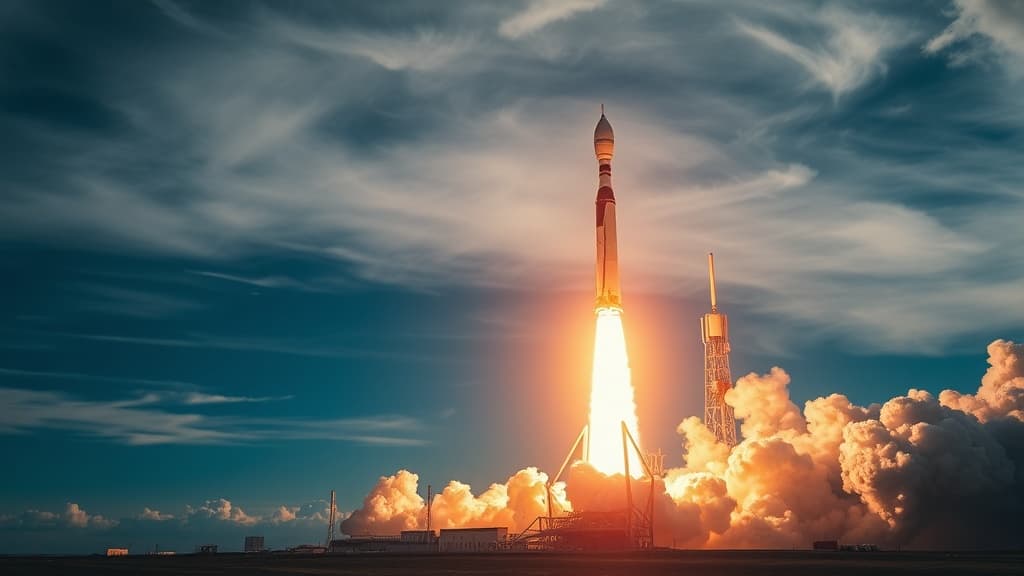
At 12:52 PM EDT on April 1, 2026, the most powerful rocket ever flown roared to life at Kennedy Space Center's Launch Complex 39B. NASA's Space Launch System, generating 8.8 million pounds of thrust, lifted the Orion spacecraft named Integrity and its crew of four astronauts off the pad and into the Florida sky. Within minutes, the twin solid rocket boosters separated, the core stage engines cut off, and the Exploration Upper Stage ignited to place Orion into Earth orbit. For the first time in more than fifty years, human beings were on a trajectory that would carry them beyond low Earth orbit and toward the Moon.
Artemis II is not a lunar landing mission. It is something arguably more foundational: a ten-day flight test of the systems that will eventually land astronauts on the lunar surface, conducted with a crew aboard for the first time. The mission will carry four astronauts around the Moon in a free-return trajectory, bringing them within approximately 4,000 to 6,000 miles of the lunar surface before the Moon's gravity slings them back toward Earth. It is the first crewed mission beyond low Earth orbit since Apollo 17 splashed down in the Pacific Ocean on December 19, 1972.
The significance of that gap cannot be overstated. An entire generation has been born, grown up, and started families without ever seeing a human being travel beyond the confines of Earth orbit. Artemis II changes that, and in doing so, it sets the stage for everything that comes after.
The Crew: Four Astronauts Making History
The Artemis II crew is a deliberately historic group, selected not only for their qualifications but for what their presence on the mission represents for the future of space exploration.
Commander Reid Wiseman leads the mission. Born on November 11, 1975, in Baltimore, Maryland, Wiseman graduated from Rensselaer Polytechnic Institute in 1997 with a degree in computer and systems engineering before being commissioned as a U.S. Navy pilot. He later earned a master's degree in systems engineering from Johns Hopkins University. Wiseman was selected by NASA as an astronaut in 2009 and flew to the International Space Station aboard Soyuz TMA-13M in 2014. He subsequently served as chief of NASA's astronaut office from 2020 through 2022. As commander of Artemis II, Wiseman bears ultimate responsibility for the crew and the spacecraft during the mission.
Pilot Victor Glover is a U.S. Navy captain and NASA astronaut who made history as the first Black astronaut to live aboard the International Space Station for a long-duration mission. Glover launched on SpaceX's Crew-1 mission in November 2020 and spent 168 days in orbit, conducting four spacewalks during his stay. With Artemis II, Glover becomes the first person of color to travel beyond low Earth orbit and toward the Moon, a milestone that carries profound significance given the historical exclusion of people of color from the highest-profile space missions.
Mission Specialist Christina Koch is an engineer and explorer whose previous spaceflight set records. She spent 328 consecutive days aboard the International Space Station during Expeditions 59, 60, and 61 in 2019, setting the record for the longest single spaceflight by a woman at that time. Koch also participated in the first all-female spacewalk alongside astronaut Jessica Meir. With Artemis II, Koch becomes the first woman to travel beyond low Earth orbit, a milestone that has been anticipated since NASA first announced the Artemis program's commitment to landing the first woman on the Moon.
Mission Specialist Jeremy Hansen represents the Canadian Space Agency and brings a unique background to the crew. A colonel in the Royal Canadian Air Force and a former CF-18 fighter pilot, Hansen was selected as a Canadian astronaut in 2009. He has contributed extensively to NASA operations, including training other astronauts and supporting mission control. Artemis II is Hansen's first spaceflight, and it makes him the first non-American to travel beyond low Earth orbit and toward the Moon. His presence on the crew reflects Canada's significant contributions to the Artemis program, including the Canadarm3 robotic system being built for the planned Lunar Gateway station.
The Mission Profile: A Figure-Eight Around the Moon
The Artemis II mission profile is carefully designed to test Orion's systems in the deep space environment while minimizing risk to the crew. Unlike the Apollo missions, which entered lunar orbit at approximately 70 miles above the surface, Artemis II follows a free-return trajectory that takes the spacecraft much farther from the Moon, at a distance of between 4,000 and 6,000 miles from the lunar surface.
The mission objectives are most comparable to Apollo 8 in 1968, the first crewed flight around the Moon. However, Artemis II's trajectory more closely resembles the path flown by Apollo 13, which used a free-return trajectory after an oxygen tank explosion forced the crew to abort their planned lunar landing. The critical difference is that Artemis II's free-return trajectory is intentional and planned, providing an inherent safety margin: if a major systems failure occurs during the translunar coast, the Moon's gravity will naturally redirect the spacecraft back toward Earth without requiring a major engine burn.
The mission unfolds in distinct phases. After launch, Orion entered a parking orbit around Earth, where the crew spent approximately two orbits checking spacecraft systems and preparing for the translunar injection burn. On Flight Day 2, the Exploration Upper Stage fired to accelerate Orion to the velocity needed to escape Earth's gravitational pull and begin the four-day coast to the Moon. NASA confirmed the successful completion of the TLI burn on April 2, 2026, marking the moment the crew officially began their journey to the Moon.
During the translunar coast, the crew is conducting a series of tests and demonstrations. These include evaluating the life support systems under deep space conditions, testing the communication systems at increasing distances from Earth, and performing trajectory correction burns to fine-tune Orion's path. On Flight Day 3, NASA reported that the crew successfully completed an outbound trajectory correction burn, confirming that the spacecraft's propulsion systems are performing as designed.
The lunar flyby is scheduled for April 6, 2026. As Orion swings behind the Moon, the crew will experience a period of loss of signal with Earth, similar to what Apollo astronauts experienced during their far-side passes. After the flyby, the Moon's gravity will redirect Orion back toward Earth for a four-day return flight, during which additional trajectory correction burns will ensure accurate reentry. The mission is expected to conclude with a splashdown in the Pacific Ocean approximately ten days after launch.
SLS and Orion: The Hardware
The Space Launch System is the most powerful rocket ever flown, surpassing even the Saturn V that carried Apollo astronauts to the Moon. The Block 1B configuration used for Artemis II features several improvements over the Block 1 variant that flew on the uncrewed Artemis I test flight in November 2022.
The core stage is powered by four RS-25 engines, upgraded versions of the Space Shuttle Main Engines that flew on 135 shuttle missions. These liquid hydrogen and liquid oxygen engines produce approximately 2 million pounds of combined thrust. Flanking the core stage are two five-segment solid rocket boosters, each generating approximately 3.6 million pounds of thrust. Together, the SLS produces 8.8 million pounds of force at liftoff, enough to accelerate the 5.75-million-pound vehicle off the pad and through the atmosphere.
The most significant upgrade for Artemis II is the Exploration Upper Stage, which replaces the Interim Cryogenic Propulsion Stage used on Artemis I. The EUS provides substantially more performance, with a payload insertion capability of 50.7 metric tons. This additional capability is essential for crewed missions, which require the heavier crew module and its associated life support systems.
The Orion spacecraft represents the crew's home for the duration of the mission. With a wingspan of approximately 63 feet when its solar array wings are fully deployed, the European Service Module provides propulsion, power, and thermal control. The service module was built by the European Space Agency, representing a significant international contribution to the Artemis program. The crew module itself provides a habitable volume of approximately 316 cubic feet, significantly larger than the Apollo Command Module's 218 cubic feet, giving the four-person crew more space during the ten-day mission.
Orion's heat shield is the largest ablative heat shield ever built, designed to withstand reentry temperatures exceeding 5,000 degrees Fahrenheit as the spacecraft returns to Earth at speeds approaching 25,000 miles per hour. The heat shield was successfully tested during Artemis I's uncrewed reentry in December 2022, though engineers noted a pattern of charring that differed from predictions, leading to additional analysis and modifications before the crewed flight.
How Artemis II Compares to Apollo
The comparisons between Artemis and Apollo are inevitable, but the two programs differ in fundamental ways that reflect the evolution of spaceflight technology and objectives over the past half century.
Apollo was conceived during the Cold War as a demonstration of American technological superiority. The program moved at extraordinary speed, going from President Kennedy's 1961 declaration to the Apollo 11 landing in just eight years. The urgency was political, and the program's funding reflected that priority. At its peak, NASA consumed approximately 4.5 percent of the federal budget.
Artemis operates in a fundamentally different context. The program aims not just to return astronauts to the Moon but to establish a sustained presence there, including the Lunar Gateway station in lunar orbit and eventually a base camp on the surface. The pace is deliberately more measured, and the budget is constrained. NASA's current budget represents less than 0.5 percent of federal spending.
The technical differences are substantial. Apollo's Saturn V used five F-1 engines burning RP-1 kerosene and liquid oxygen in its first stage. The SLS uses liquid hydrogen and liquid oxygen throughout, with solid rocket boosters providing the majority of liftoff thrust. The Apollo Command Module carried three astronauts in a habitable volume of 218 cubic feet. Orion carries four astronauts in 316 cubic feet, with modern life support systems, digital avionics, and a glass cockpit that would be unrecognizable to Apollo-era astronauts.
Perhaps the most significant difference is the trajectory. Apollo missions entered low lunar orbit at approximately 70 miles altitude, giving astronauts close-up views of the surface and enabling the Lunar Module to descend to landing. Artemis II passes the Moon at a much greater distance, between 4,000 and 6,000 miles, because its objective is to test systems in the deep space environment rather than to prepare for an immediate landing.
The crew composition also reflects a different era. Apollo astronauts were exclusively white American men, most of them military test pilots. The Artemis II crew includes the first person of color, the first woman, and the first non-American to travel beyond low Earth orbit, a deliberate statement about who the future of space exploration belongs to.
The Road to Artemis II: Delays and Determination
The path to this launch was not smooth. Artemis II was originally scheduled to launch in November 2024, but a series of technical issues forced repeated delays. The most significant concerned the Orion heat shield, which showed unexpected charring patterns during the Artemis I reentry in December 2022. Engineers spent months analyzing the issue and implementing modifications to ensure crew safety.
Additional delays arose from problems with the batteries in the crew module's life support system and from supply chain challenges affecting the Exploration Upper Stage production. The stacking of the SLS rocket was completed on October 20, 2025, with the installation of the fully integrated Orion spacecraft, European Service Module, and launch abort system atop the rocket.
On January 18, 2026, the integrated stack was rolled out from the Vehicle Assembly Building to Launch Complex 39B, where it underwent final preparations and a series of countdown rehearsals. NASA officially began the launch countdown on March 30, 2026, and the mission proceeded to launch on April 1 without significant technical holds.
The delays, while frustrating for those eager to see humans return to the Moon, reflected NASA's post-Columbia commitment to crew safety. Every anomaly identified during Artemis I was investigated and resolved before a crew was placed aboard the vehicle.
What Artemis II Means for Artemis III and Beyond
Artemis II is fundamentally a pathfinder mission. Its success validates the SLS and Orion systems for crewed deep space operations, clearing the way for Artemis III, which is planned to achieve the first crewed lunar landing since Apollo 17.
Artemis III is currently targeted for 2028 and will use SpaceX's Starship Human Landing System to transport astronauts from Orion in lunar orbit to the surface of the Moon. The landing is planned for the lunar south pole region, where scientists believe permanently shadowed craters contain water ice that could be used to support long-term human presence.
Beyond Artemis III, NASA's plans call for the construction of the Lunar Gateway, a small space station in lunar orbit that will serve as a staging point for surface missions and as a platform for scientific research. The Canadian Space Agency's Canadarm3 robotic system will be a key component of the Gateway, and Canada's contribution is one of the reasons a Canadian astronaut was included on the Artemis II crew.
The longer-term vision extends beyond the Moon entirely. NASA has stated that the Artemis program is designed to develop the technologies and operational experience needed for eventual crewed missions to Mars. The deep space environment between Earth and the Moon serves as a proving ground for the life support systems, radiation protection, and mission operations that will be required for the months-long journey to Mars.
The Global Reaction
The launch of Artemis II generated a level of public interest that surprised even NASA officials. An estimated 300,000 spectators gathered along Florida's Space Coast to watch the launch in person, while NASA's live stream drew tens of millions of viewers worldwide. Social media platforms were flooded with images and reactions, and the mission briefly dominated global news coverage.
The crew has been sharing images from the mission, with photos published by NASA and shared by outlets including NPR and CNN showing Earth receding in the distance and the zodiacal light visible against the backdrop of deep space. These images serve as a powerful reminder of what human spaceflight can achieve that robotic missions cannot: a visceral, emotional connection between the people watching from Earth and the people looking back at it from farther away than any human has traveled in over fifty years.
International partners have also reacted with enthusiasm. The European Space Agency, which built the Orion service module, celebrated the successful launch and nominal performance of its hardware. The Canadian Space Agency marked the historic moment of its first astronaut traveling beyond low Earth orbit. And space agencies around the world have expressed renewed interest in collaborative lunar exploration.
What Comes Next for This Mission
As of April 4, 2026, the Artemis II crew aboard Orion continues its outbound trajectory toward the Moon, with the lunar flyby scheduled for April 6. The crew is monitoring spacecraft systems, conducting planned experiments, and preparing the cabin for the flyby phase of the mission. NASA is providing regular updates through its mission blog and live coverage.
The four-day return flight after the lunar flyby will include additional trajectory correction burns to ensure accurate Earth reentry. The mission is expected to conclude with a splashdown approximately ten days after launch, bringing the crew home and marking the successful completion of the first crewed deep space mission in over half a century.
For now, four human beings are farther from Earth than anyone has been since 1972, and the Moon is getting closer. The Artemis era is no longer a plan on paper or an uncrewed test flight. It is real, it is happening, and it is carrying humanity back to the Moon.
Was this article helpful?
Join the conversation — sign in to leave a comment and engage with other readers.
Loading comments...
Related Posts
ai
OpenAI Closes Record Funding Round: What the Largest AI Deal Ever Means
Apr 4, 2026cybersecurity
Chrome Zero-Day CVE-2026-5281: What You Need to Know About the WebGPU Exploit
Apr 5, 2026industry
Oracle's Massive Layoffs: 30,000 Jobs Cut While AI Spending Soars
Apr 5, 2026deals
Best Dell Spring Sale 2026 Deals: Up to $700 Off Laptops, Monitors, and Alienware
Apr 4, 2026Enjoyed this article?
Get the best tech reviews, deals, and deep dives delivered to your inbox every week.